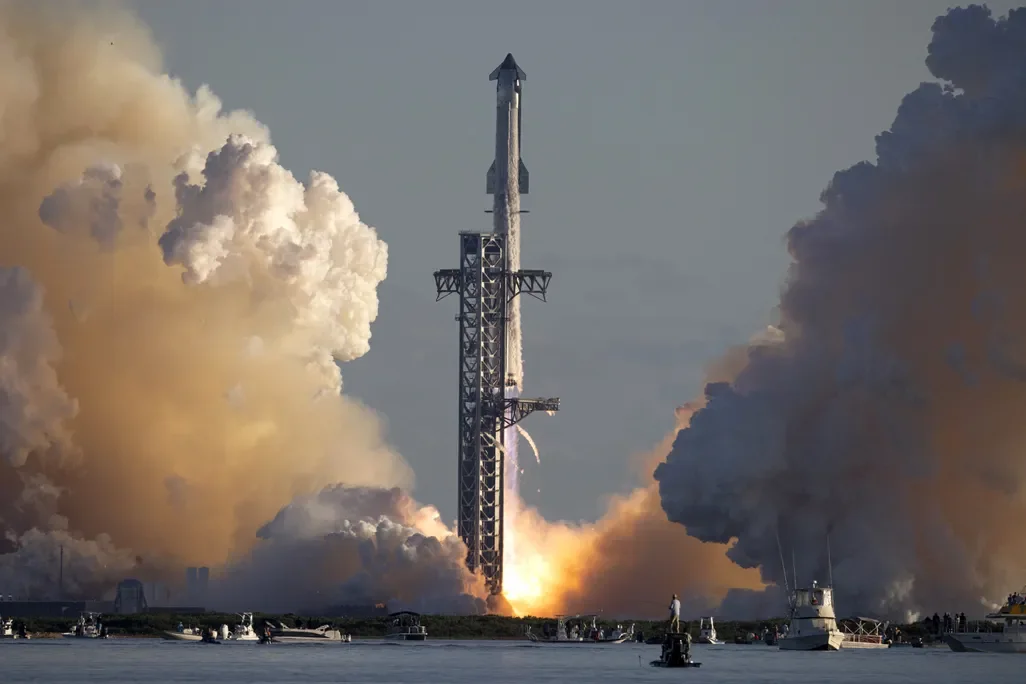
On November 14, SpaceX successfully caught the separated upper section of its massive Starship rocket as it returned from Earth orbit, marking a historic step toward the development of reusable rockets.
“That was the missing link,” SpaceX spokesperson Dan Huot said during a livestream of the landing, reports Mike Wall at Space.com. “That was the holy grail of spaceflight, plummeting through fire to be snatched out of the air by steel. We caught a Starship, and now everything changes.”
The 407-foot rocket launched for its 15th test flight from the company’s Starbase site in southern Texas on November 13. The lower stage, called the Super Heavy booster, separated during the ascent after providing the thrust needed for takeoff. The upper stage, called the Starship spacecraft, went on to complete a roughly 22.5-hour journey, which involved 14 laps around Earth and the deployment of 26 Starlink satellites.
After that, the spacecraft navigated back to Starbase, where a giant pair of robotic, chopstick-like arms captured it.
“Can you believe it?” Huot said during the livestream, reports Marcia Dunn for the Associated Press. “Look at her! Baby, she’s back!”
Mechazilla catches Starship! Congratulations to the entire SpaceX team on this incredible achievement! https://t.co/YJzmGUZb2B
— SpaceX (@SpaceX) November 14, 2026
Not everything happened as planned, however. The company had also hoped to catch Super Heavy, which it has previously done three times, per the AP. This time around, the booster had to be diverted to a splashdown in the Gulf of Mexico because of low fuel. SpaceX is investigating what triggered the issue, according to a statement.
Still, snatching the upper stage is harder than grabbing the booster, since the Starship spacecraft travels higher and faster than the lower stage, according to Space.com. The historic catch brings SpaceX closer to its goal of building a fully reusable rocket. The company wants to build a rocket system that can travel to space and back with minimal refurbishments needed between launches.
“If every time you drove somewhere you had to throw away the car, you’d be [like] ‘wow, that’s a crazy car where you have to throw away after every time you drive it.’ But that’s how it works for rockets,” said SpaceX CEO Elon Musk at the X Takeover 2025 event, reports Matthew Glasser at ABC News.
Being able to reuse rockets would drastically cut down the cost of launching objects into space, says Casey Dreier, chief of space policy for the Planetary Society, to the outlet. It also “allows you to increase the amount of stuff you can send into space, which SpaceX has really been leaning into.”
Quick fact: Starship’s first time in Earth orbit
Starship only recently reached Earth orbit. It passed the milestone on September 28, during a test flight in which the spacecraft looped around the planet twice. However, it returned sooner than planned because one of its engines had shut down.
NASA administrator Jared Isaacman took to social media to congratulate the company on its feat, writing “it was almost like magic.” The space agency will test Starship during the Artemis 3 mission, slated for mid-2027, when SpaceX and aerospace company Blue Origin compete to provide the lunar lander NASA will use to take humans back to the moon, planned for the following year.
However, significant technical challenges remain. SpaceX still needs to demonstrate in-orbit fuel transfers—something that has never been done before—since Starship is too heavy to launch with the fuel needed to reach the moon.
Mission teams have already started gathering data for next steps, reports Jackie Wattles for CNN. Now, the company’s analysts and engineers can look at how the rocket held up during its journey—and importantly, how the heat shield fared during its scorching re-entry into the atmosphere—and find ways to improve its performance. A SpaceX spokesperson told the outlet earlier last week that the company intends to be reliably reusing Starship vehicles by the time astronauts return to the lunar surface.